NSE, BSE, and Nifty: Decoding the “Alphabet Soup” of Indian Investing
Welcome back! In our last post, we realized that staying in an FD is like running a race in quicksand. You are moving, but you are sinking. So, you have decided to step onto the racetrack of the Indian Stock Market.
But as soon as you open a news channel, you hear: “Nifty is up by 100 points,” or “Sensex hits a new all-time high.” If you are scratching your head thinking, “Who is Nifty, and why should I care?, this post is for you. Let us break down the “Great Indian Market Bazaar” into plain English.
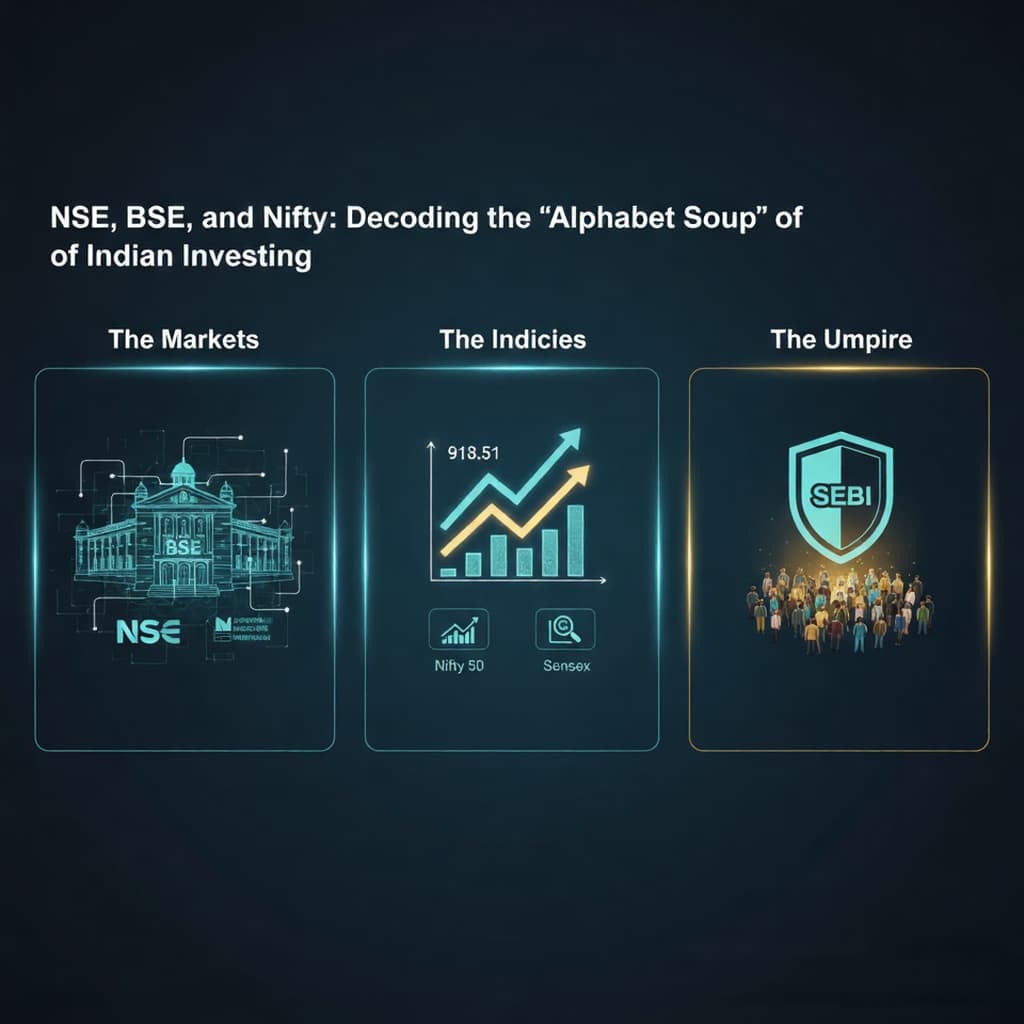
1. The Exchanges: NSE and BSE (The Markets)
Think of the Stock Market like a massive digital vegetable market (Sabzi Mandi).
- BSE (Bombay Stock Exchange): This is the “Old Grandfather” of exchanges. Established in 1875, it is one of the oldest in Asia. It is located on the iconic Dalal Street in Mumbai.
- NSE (National Stock Exchange): This is the “Tech-Savvy Youth.” It started in the 1990s and brought fully screen-based electronic trading to India.
Do you need to choose? Not really. Most big companies are listed on both. As a beginner, it does not matter much where you buy from, the price will be almost identical.
2. The Indices: Sensex and Nifty (The Thermometers)
With over 5,000 companies listed on the BSE and 2,000+ on the NSE, you can’t track every single one. You need a “summary” to know if the market is healthy or sick. This summary is called an Index.
- The Sensex: A collection of the 30 largest, most financially sound companies on the BSE. If these 30 giants are doing well, the Sensex goes up.
- The Nifty 50: A collection of the 50 most important companies on the NSE, spread across various sectors like Banking, IT, and Energy.
3. SEBI: The “Umpire” Who Has Your Back
Many beginners fear that the stock market is a “scam.” In the 1990s, that might have been a concern. But today, we have SEBI (Securities and Exchange Board of India).
Think of SEBI as the strict Umpire in a Cricket match.
- They make sure companies don’t lie in their reports.
- They ensure your broker does not run away with your money.
- They keep the “Big Players” from bullying the small investors.
Thanks to SEBI, the Indian stock market is now one of the most transparent and well-regulated markets in the entire world.
4. How the Money Moves: The T+1 Cycle
In 2026, India is a global leader in settlement speed. When you sell a stock today, the money and ownership transfer happen in T+1 days. “T” is the day you trade; “+1” is the very next working day. It is fast, digital, and incredibly secure.
Your Action Step for Today:
Don’t worry about picking a stock yet. Just do this:
- Open Google.
- Type “Nifty 50 companies list.”
- Look at the names. You will see brands you use every day, Britannia (biscuits), SBI (banking), Maruti (cars).
Realize that the market is not a “monster.” It’s just a collection of the companies that run our country.
Pingback: The Fixed Deposit Trap